
 sreepvfkrishna@gmail.com
 One Simple Innovation Helping India’s Farmers Save Their Produce, and Their Income
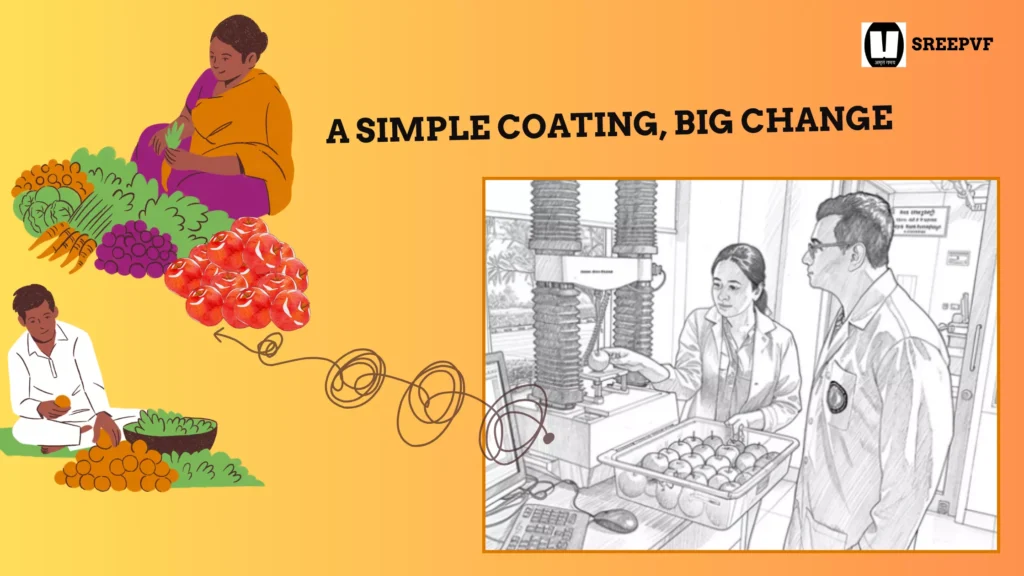
A quick round along the aisles of one of your posh neighborhood supermarkets will have you look at some of the glossiest fruits and vegetables, that don’t seem to have ‘aged’ a day older than when it was first plucked from the plant! Imagine, on the other hand, going to one of the busiest vegetable and fruit ‘mandis’ in your area – the produce is sometimes sold by the farmers themselves – and will look fresh, a bit uneven, sometimes still speckled with soil. This contrasting scenario in many Indian cities highlights a harsh truth: many small and marginal farmers in our country have no access to sophisticated post-harvest technologies that prevent spoilage, resulting in substantial losses long before the harvest can earn them its full value.
When Dr. Koushik Mazumder, a Scientist from BRIC-National Agri-Food and Biomanufacturing Institute, Mohali, first began studying ways to keep farm produce fresh for longer, he wasn’t thinking about supermarket shelves or glossy produce displays. He was thinking about the quiet, unseen losses our farmers face, losses that occur sometimes long before their produce even reaches a market.
India is the world’s second-largest producer of fruits and vegetables, yet nearly 25–30% of this produce is lost every year due to spoilage. The numbers are alarming: a study by the NABARD Consultancy Services (NABCONS) estimates post-harvest losses of 1.5 trillion rupees annually across 54 crops! Most of this waste happens not because the produce is inferior, but because small-scale farmers (constituting around 86% of all farmers in India) lack access to affordable cold storage, modern post-harvest treatments, or sustainable preservation technologies.
Dr. Mazumder and team focused on a simple but powerful idea: transforming agricultural by-products into edible coatings. Conventionally used coatings, though edible, are often made from shellac derived from lac insects. Uniform application of such coatings, in bulk, need factory-scale equipment which are inaccessible to most farmers in the country. Dr. Koushik’s team developed thin, biopolymer-based natural coatings that serve as protective jackets for fruits and vegetables, slowing moisture loss, delaying ripening, and shielding against microbial infection. Not only do these coatings improve post-harvest shelf-life of farm produce, but they can also be applied right at the farm, while being consumer-friendly!
Sourced from biopolymers extracted from wheat straw and oat bran – agricultural by-products that are often underutilized – these coatings are natural and eco-friendly, and show excellent results. Dr. Mazumder explains, “Our laboratory experiments proved that they extended the shelf life of apples up to 30 days at room temperature and more than six months in commercial cold storage, outperforming conventional wax coatings like shellac”.
From Concept to Technology
For Dr. Mazumder and his team, the end-goal of their innovation was clear: create a technology simple enough to be used at the farm level, not just in large factory settings. Their edible coating requires no sophisticated machinery, and when paired with an electrostatic coating system, it becomes even more efficient and suitable for farmers’ use, aiding their income stability.
Dr. Mazumder shares, “This vision began taking shape through the support of the SreePVF grant we received in 2022. The funding was timely, consistent, and catalytic, helping us to meet every milestone, all the way to the final step: technology licensing for commercialization.”
Beyond the monetary aspects of the funding Dr. Mazumder shares that the Foundation’s excellent Review Committee offered invaluable guidance that steered the project forward. For Dr. Mazumder and team this mentorship aspect stood out, helping them add momentum to the project.
Real-world impact and looking ahead
One of the most exciting outcomes for the project came when the ‘Edible Fruit Coating’ technology found a commercial partner in Cirkla Technologies Pvt. Ltd., Mumbai. Their collaboration is set to drive this innovation far beyond the lab bench to farms nationwide as a sustainable alternative to conventional shellac coating, while empowering farmers with access to an effective tool against post-harvest losses.
Dr. Mazumder believes the future of sustainable fruit preservation in India is bright. “Simple, cost-effective innovations like edible coatings can transform the agricultural landscape,” he says, while adding that “technologies such as these also help farmers create new value from agricultural by-products.”
The story of Dr. Mazumder and team shows that the most transformative solutions don’t always spring from the most complex ideas. Instead, it comes from paying attention to the quiet challenges on the ground, and crafting solutions that are certain to reach those that need them the most. And thanks to support from foundations like SreePVF, these solutions are not just ideas in a lab, they’re tools in the hands of farmers across India.
